

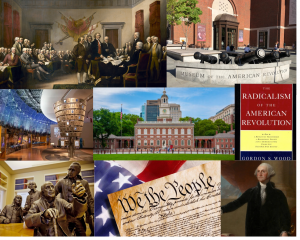
Authoring America
Akhil Reed Amar, Yale University
Gordon Wood, Brown University
Kermit Roosevelt III, University of Pennsylvania
EverScholar in Philadelphia
March 5-8, 2026
At The Museum of The American Revolution
$2795 per person
EverScholar invites you to an extraordinary intellectual weekend in the heart of Philadelphia, where America put pen to paper, creating a series of documents that began a process – 250 years ago – which will eventually produce Gordon Wood’s recently expressed notion of a “creedal nation.” Authoring America brings together three of the nation’s most esteemed constitutional and historical scholars—Gordon S. Wood, Akhil Reed Amar, and Kermit Roosevelt III—for a searching, layered exploration of not only the great texts, not only the monumental history, but the depth and nature of the relationship among these forces that made (and remade) the United States. Did the documents emerge inevitably from the history of the colonies and the early Republic? What did the history generate that is encoded – and what is not encoded – in our creedal inscriptions? How do the dynamics of history, which bring the Founders together in this city several momentous times, write themselves on these author-delegates, and how does this mandate our understanding of the meaning of the words, even today, 250 years later?
Held at the Museum of the American Revolution, this immersive program places participants in the very landscape where the nation’s earliest authors grappled with liberty, power, identity, union, and the always-unfinished project of self-government.
Beyond the landscape, however, EverScholar brings together the greatest scholars of this period, in an unforgettable intellectual exploration that you will be an integral part of, as our EverScholar interactive seminar format brings you into the discussion at every turn.
Across three days of 90-minute seminars—each day featuring one seminar led by each professor, but with the other faculty participating as well—you will examine America’s foundational documents as both products of their time and living forces that shape the nation still. Drawing inspiration from many texts, including primary sources such as the documents themselves, The Federalist, and much more, the classic analyses of the period – written by these professors – including The Radicalism of the American Revolution, America’s Constitution: A Biography, The Nation That Never Was, (and many more) and their enduring insights.
The course takes as its central theme the idea that America’s founding documents are authored not only by individuals—Jefferson, Madison, Hamilton, Lincoln—but also by the deeper historical forces that shaped their world. These texts reflect the pressures, aspirations, and contradictions of their moment, even as they reorder those forces and redirect the American story.
Each of our three lead scholars brings a distinctive lens to this inquiry:
Gordon S. Wood, the preeminent historian of the revolutionary era, perhaps the greatest to ever live, will guide participants into the social and ideological upheavals that made the American founding possible. His seminars will explore how the Revolution’s profound transformation of society—from monarchical subjects to self-governing citizens—finds expression in colonial life, politics, and ideology; from there into state constitutions; and then steadily into our America-creating documents including the Declaration of Independence, the Articles of Confederation, and the Constitution. Professor Wood will help us see these developments, and these documents, as reflections of a radical break with the Old World, infused with the republican ideals, anxieties, and experimental spirit of the era.
Akhil Reed Amar, one of the country’s most influential constitutional scholars, will bring his hallmark blend of textual close-reading, structural analysis, and democratic theory to the Constitution and Bill of Rights. Known for uncovering the deep logic and interconnections woven through America’s constitutional architecture, Professor Amar will illuminate how these documents encode the revolutionary ideals Wood describes—sometimes straightforwardly, sometimes with exquisite complexity. His sessions will likely trace how constitutional text, design, and later amendments articulate a vision of popular sovereignty, federalism, and individual rights that continues to evolve. Amar’s approach invites both originalists and non-originalists to engage the Constitution as a vibrant, intergenerational project. His monumental trilogy, including the recently published and acclaimed Born Equal, follows the Constitutional Conversation through the founding period, into, and beyond the Civil War, delving into the very questions at the center of this program.
Kermit Roosevelt III, acclaimed scholar of constitutional interpretation and author of The Nation That Never Was, will guide participants through an exploration of how the colonial perspective, focused perhaps primarily on independence from Britain, created documents which while perhaps limited at their creation, nevertheless had an afterlife in the form of the founding documents – resulting in successive generations expanding their understanding, reinterpreting, or departing from them. His work in part highlights how Lincoln’s “new birth of freedom,” Reconstruction, and the modern civil-rights era re-authored the American project in ways that both honor and transform the founding vision. Roosevelt will help us explore how history has followed the founding documents forward—or diverged from them—and how constitutional meaning is shaped not only by text and origins but also by national experience and moral development.
Together, these approaches create a rich dialogue across time: from the radical impulses that birthed the American experiment, to the constitutional structures that gave it form, to the interpretive struggles that continue to redefine it. The course invites participants to consider how America’s documents emerged from history—and how they continue to author the nation even now.
Participants will enjoy specially curated tours of the Museum of the American Revolution, the National Constitution Center, and some surprises to come —each setting offering new dimensions to our seminar discussions. Whether standing before Washington’s headquarters tent, examining early drafts of the Constitution, or walking the rooms where delegates argued over the fate of a continent, students will encounter the written and unwritten origins of the republic with unmatched immediacy.
Authoring America is a rare opportunity to study the nation’s foundation – texts and histories – with three master teachers, in the city that gave them life. Join us as we explore how and why America’s documents came to be—and how, across centuries, Americans have continued the work of authoring their own nation.
Our Faculty:
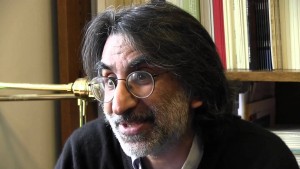
Sterling Professor of Law and Political Science
Yale University
Akhil Reed Amar is Sterling Professor of Law and Political Science at Yale University, where he teaches constitutional law in both Yale College and Yale Law School. After graduating from Yale College, summa cum laude, in 1980 and from Yale Law School in 1984, and clerking for now-Justice Stephen Breyer, Amar joined the Yale faculty in 1985 at the age of 26. He is the winner of Yale’s DeVane Medal for teaching, and in 2017 he received the Howard Lamar Award for outstanding service to Yale alumni. He is the author of eight books, including America’s Constitution, A Biography, and most recently, The Words That Made Us: American’s Constitutional Conversation, 1760-1840. He has co-led or been guest professor for courses with the EverScholar model on several occasions over the past 11 years. He co-hosts a weekly podcast, “Amarica’s Constitution,” with EverScholar President, Andy Lipka.
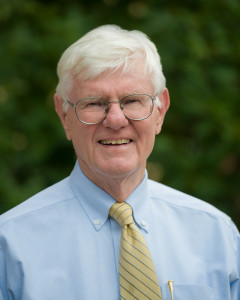
University Professor Emeritus of History
Brown University
Gordon S. Wood, the nation’s most decorated historian, received his B.A. from Tufts University and his Ph.D. from Harvard University. He is the author of many works, including The Creation of the American Republic, 1776-1787 (1969), which won the Bancroft Prize and the John H. Dunning Prize, and The Radicalism of the American Revolution (1992), which won the Pulitzer Prize for History and the Emerson Prize in 1993. The Americanization of Benjamin Franklin (2004) was awarded the Julia Ward Howe Prize. His volume in the Oxford History of the United States, Empire of Liberty: A History of the Early Republic, 1789-1815 (2009) was given the American History Book Prize. In 2011 he was awarded a National Humanities Medal by President Obama. Professor Wood is a fellow of the American Academy of Arts and Sciences and the American Philosophical Society. He has taught in several EverScholar programs to great acclaim.
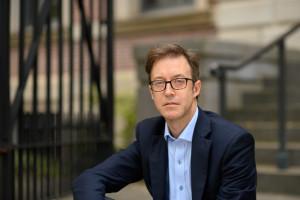
David Berger Professor for the Administration of Justice
University of Pennsylvania Carey Law School
Kermit Roosevelt works in a diverse range of fields, focusing on constitutional law and conflict of laws. He has published scholarly books in both fields. His most recent book, The Nation That Never Was (Chicago, 2022) suggests a revisionist interpretation of American history that offers a new origin story for the nation. He is also the author of two novels, In the Shadow of the Law, and Allegiance. In 2021 he was appointed to President Biden’s Commission on the Supreme Court. In 2014, he was selected by the American Law Institute as the Reporter for the Third Restatement of Conflict of Laws. Before joining the Penn faculty, he clerked for Judge Stephen F. Williams on the D.C. Circuit and Justice David Souter on the U.S. Supreme Court. (Photo credit: Sameer Khan/Fotobuddy)
Readings
All EverScholar courses actually start months before our meeting. After registration, you will receive all books and scholarly articles for the course, and will immerse yourself in great works curated by our faculty. “Authoring America” is no exception, with works ranging from contemporaneous writings to great books written by your own EverScholar professors. Primary sources will mix with authoritative texts to produce night after night of joy as you prepare for your return to the life of the mind.
Special Events
One of EverScholar’s unique and most beloved features are our Special Events; sessions at a number of well-known (such as a museum or Art Gallery) or less-known centers of collection and learning. “Authoring America” continues this tradition. Details of the Special Events for this program will be provided before the program begins, but we anticipate a robust program with our hosts at the Museum of the American Revolution, as well as the nearby National Constitution Center, which was founded in part by several of our faculty. The nearby landmarks around Independence Mall are likely to play a prominent role as well.
Beyond the Classroom
Everything that happens during an EverScholar program is enhanced by the fact that it takes place in a learning-promoting environment.
This program will take place in Philadelphia, PA. EverScholar will arranged for a discounted block of rooms at a nearby excellent hotel. The learning environment will enhance our classes both in beauty and the nature of the location.
Learn more about the experience!

The course begins with a reception and dinner on Thursday…. and ends in late afternoon Sunday. The program cost is $2,795 per person. Deposit is $500 per person. Balance is due on January 15, 2026. Cancellation refund and COVID-19 refund policies are detailed on the registration page – so you can register without worries.
All EverScholar program attendees are required to be fully “up-to-date” on covid vaccination; we also request rapid testing on the day the course begins.
Looking forward to seeing you there!